Marjorie Lynn
Director of Education at RenovaBR
Brazilian politics remains one of the most hostile and resistant environments to the presence of women, especially Black, Indigenous, peripheral, and LGBTQIAPN+ women. Despite comprising more than half of the population and the electorate, we remain dramatically underrepresented. In 2025, according to data from the TSE (Superior Electoral Court), only 18% seats in the National Congress will be held by women. In municipalities, the situation is even more alarming: in 737 Brazilian cities, no women were elected city councilors, and only 13% city halls have women in charge. The intersection of gender, race, and territory throws open the question we should have been asking for some time: which women are coming to power, and at what cost?
It's impossible to look at these data without addressing the structural inequality that underpins them. The Municipal Electoral Inequality Map, released by RenovaBR, shows that female city council candidates received, on average, 42% less campaign funding than their male counterparts. This funding disparity helps explain why women's electoral success rate was only 6,93%, compared to 17,1% for men.
Still, the most pressing question in 2025 is no longer whether we need more women in politics. That's a given. What we need to know is: how can we ensure that women not only arrive, but remain, exercising power with autonomy, security, and legitimacy?
Persistence is the real challenge. And to face it, we need to name what prevents us from moving forward: overload with care work, institutional racism, male-dominated networks of influence, unequal funding, and a political culture that, to this day, is not designed for us. This environment doesn't just alienate women. It sickens, violates, and punishes those who "dare" to occupy it.
Even when they overcome the barriers of election, many women face another silent obstacle: the authority gap. British journalist Mary Ann Sieghart describes this phenomenon as the gap between a woman's actual authority and the extent to which she is recognized as legitimate to exercise it. In Brazil, this translates into councilwomen being ignored in legislative sessions, mayors being disavowed by their secretaries, and female leaders being constantly questioned, even when more prepared than their male counterparts. Systematic distrust of women's competence is a form of symbolic violence that corrodes democracy from within.
This ongoing delegitimization is compounded by more explicit forms of violence. A recent study by the National Confederation of Municipalities reveals that more than 601 female mayors and deputy mayors have experienced gender-based political violence. Reports range from verbal harassment (491 female mayors) to psychological pressure (451 female mayors) and even physical violence (5,61 female mayors). More than half reported impacts on their personal lives, and 36,51 female mayors said this violence directly affected their ability to govern. This explains why so many women withdraw from running for reelection or abandon public life even after being elected. Politics, as it stands, still exacts a heavy toll on those who dare to remain.
Despite all this, there are reasons to be hopeful realists, as Ariano Suassuna would say. Support networks, movements of Black, Indigenous, and peripheral women, and training programs like those we develop at RenovaBR have been trenches of resistance and transformation. More than 1,380 women have attended our courses. And in the 2024 elections, 26% of the elected officials from our network will be women, almost double the national average. These numbers prove what we already know: the problem was never a lack of interest, capacity, or vocation among women. The problem is structural.
Political education is key, but it alone won't solve the problem. It's urgent that parties, the state, and society take concrete responsibility: fair distribution of electoral funds, quotas for party leadership, effective mechanisms to combat political violence, public policies that redistribute care work, and safety nets so that no woman has to choose between her mental health and her mandate.
And there's a path to change through citizenship as well. Every two years, Brazilians have the chance to rethink the direction of politics in the country, and this includes the presence of women in decision-making spaces. Beyond highlighting the obstacles within power structures, it's urgent to recognize that female underrepresentation is also a result of choices made at the ballot box. In October 2026, we have a new opportunity to rethink our collective commitment to gender equality in politics.
When women hold power, the public agenda changes. Policies for childhood, health, education, and combating hunger and inequality advance. More collaborative and empathetic forms of politics also advance. But transformation cannot last long. There is no justice without support.
Brazilian democracy will not be complete until politics reflects, in practice, the diversity of who we are. This means more than counting women. It means ensuring that Black, Indigenous, quilombola, trans, mothers, LGBTQIAPN+, women with disabilities, and women from peripheral communities are at the center of decision-making. And to achieve this, it's not enough to simply open the door. We must ensure they have a place to sit, a place to speak, and that they are heard.
If we want a politics capable of transforming Brazil, it must also be driven by women who have historically been pushed to the margins. And this requires collective courage: to pave the way for those who bravely put themselves forward at the polls, but also to support, protect, and care for those already within the ranks.
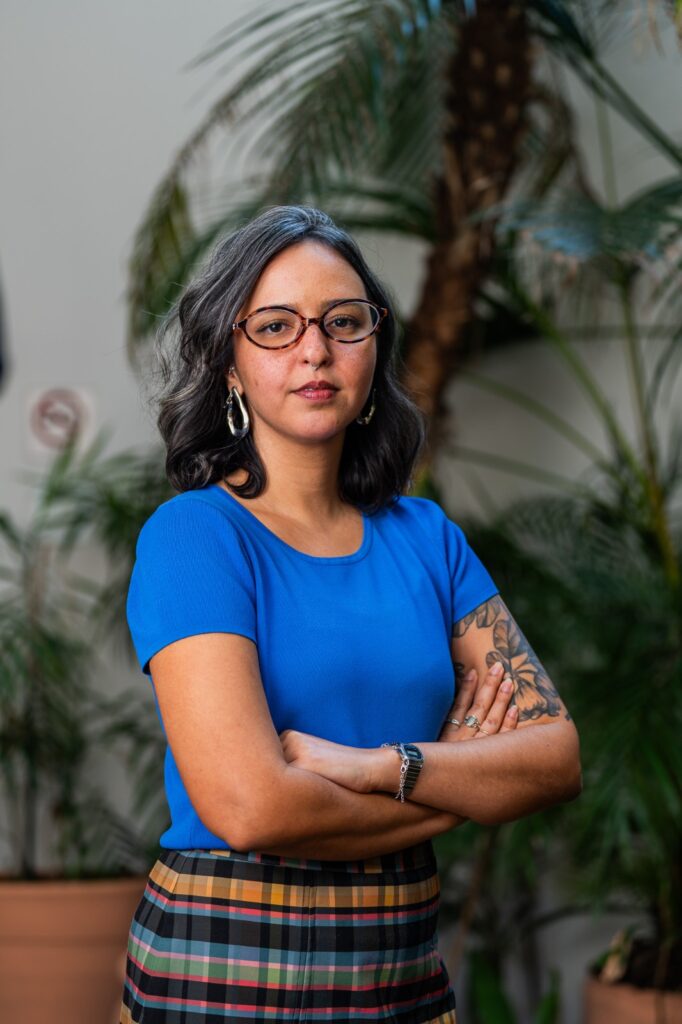
Photo: Marisa Zimermman
Marjorie Lynn is Director of Education at RenovaBR. Master in Political Science from the Federal University of Goiás (UFG). Graduated in Public Policy Management from the University of Brasília (UnB) and specialized in Management and Public Policy from Ibmec. She worked in public management consulting from 2016 to 2018. She was Executive Coordinator of Civic Auditing at the Institute of Oversight and Control in 2019. She worked as Social Control Manager at the Comptroller General's Office of the State of Goiás.


